
Public attitudes toward corruption in Albania indicate a slight improvement in moral rejection of corrupt practices, while simultaneously revealing a high level of susceptibility to engagement in corruption under pressure.
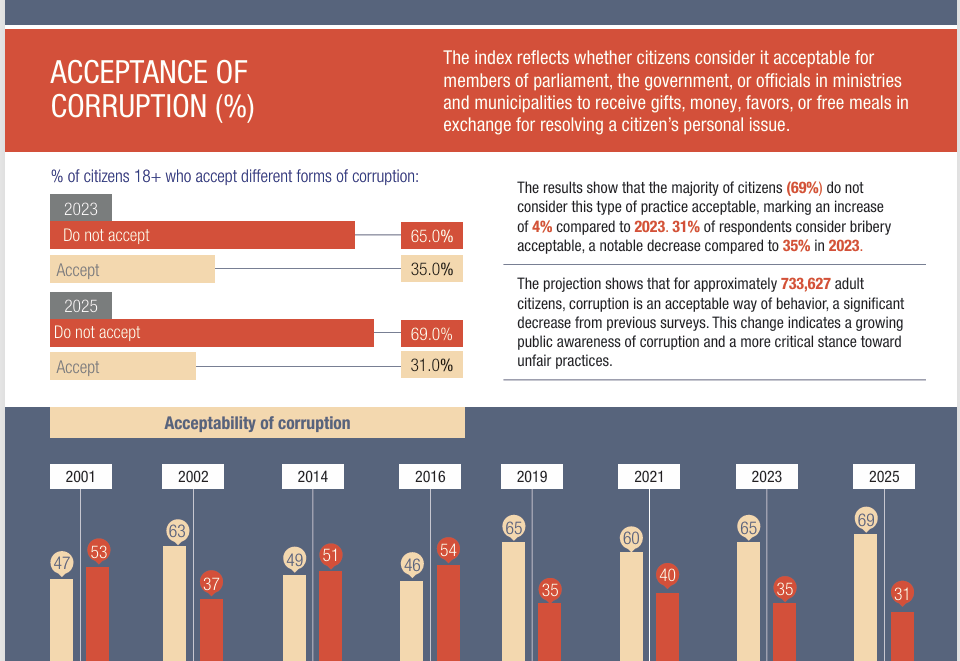
Data from the Corruption Monitoring System (CMS 2025) show that 69% of citizens consider bribery unacceptable, marking a 4-percentage-point increase compared to 2023. However, 31% of respondents continue to view corruption as acceptable, which, in population projections, translates into approximately 733,627 adult citizens who justify bribery under certain circumstances.
At the same time, the corruption susceptibility index indicates that 56% of citizens are classified as susceptible to corruption, meaning they are likely to compromise their values when faced with pressure. Meanwhile, 18% are classified as not susceptible, while 26% display mixed behavior, oscillating between rejecting and justifying corruption depending on the context.
These findings suggest that although public awareness and critical attitudes toward corruption have strengthened, a significant portion of society remains vulnerable to practical pressures and situational incentives. Strengthening institutional integrity and reducing opportunities for corrupt exchanges remain essential to translating moral rejection into consistent anti-corruption behavior.
Read full infographic (Albanian)
 SQ
SQ  EN
EN